Learn how product photography pricing works, which quote line items hide costs, and when AI product photography can help.
Last year I launched a new product and needed some white background photos. Simple enough, right? I contacted a few local studios for quotes.
The first charged per image—£25 each. The second charged per day—£300 for a full day. The third quoted per project—£200 for 10 products. I stared at three completely different quotes and had absolutely no idea how to compare them. Then, when I went with the cheapest option, the final bill came in 40% higher than the quote. Why? "Reflective material surcharge," "clipping paths extra," and "retouching beyond basic scope."
That experience sent me down a rabbit hole. I spent months researching product photography pricing, and I've since tried DIY, freelancers, professional studios, and AI tools. Here's what I've learned—hopefully it saves you some headaches.
How Photographers Actually Charge
First thing you need to know: there's no standard model. I've come across at least six different ways.
Per image is the most straightforward, but "one image" can mean wildly different things—it might be one angle, one product, or one complete scene. Editing might be on top.
Per product usually includes a set number of images, but how many and at what angles varies enormously.
Per hour sounds fair, but shooting hours and editing hours are often billed separately. You think it's a two-hour job; it turns out to be one hour of shooting and three hours of retouching.
Half-day or full-day rates are common for bigger shoots, but typically don't include retouching, props, or usage rights.
Project-based pricing is popular for Amazon listing work, but line items are often opaque and add-ons are frequent.
Monthly retainers sound lovely, but transparent monthly pricing for product photography is genuinely rare—most are custom-negotiated.
AI tools charge differently again: credits, subscriptions, pay-as-you-go, team plans. Understanding which model you're looking at is the first step to comparing costs fairly.
The Hidden Costs in Your Quote
I learned the hard way how those line items add up.
Once I was quoted a reasonable price for a set of skincare products. The final bill came in 30% higher. Why? Reflective material surcharge, background removal extra, and retouching "beyond basic scope."
Another time, the quote said "basic retouching included." I assumed that meant clipping, colour correction, and blemish removal. Turns out "basic retouching" only covered colour and blemishes—clipping paths were £1.50 per image extra. With 10 products and three angles each, that added up fast.
Here's what to watch for when you're reviewing a quote:
Number of products affects per-unit cost—bulk shooting usually brings the price down because setup time gets spread across more items. But exactly how that's calculated varies.
Angles per product—in a per-image model, each angle is typically another fee.
White background vs styled scenes—white background is fastest and cheapest. Styled shots need props, set design, and more post-production.
Props and styling—add surfaces, backgrounds, and creative setups, and costs climb quickly.
Models and hair/makeup—model fees, stylists, and MUAs all add up. I once asked about a lifestyle shoot with a model: starting price was £400, no upper limit.
Product prep—steaming, lint removal, assembly, wire management. Never free, just not always listed separately.
Retouching and clipping—basic cleanup might be included, but extensive editing is almost always extra. Clipping paths run about £1-2 per image; complex retouching can be £60+ per hour.
Complex materials—reflective, transparent, jewellery, and metallic products nearly always cost more. I had a set of metal jewellery quoted at double the normal rate.
Rush delivery—typically adds 50–100%.
Usage rights—some quotes include unlimited royalty-free usage; others don't. Large campaign usage might require separate licensing.
Revisions—most include one round. Additional rounds or changes to the brief cost more.
Shipping—if you need to send products to a studio, factor in shipping, return shipping, and insurance.
Why Some Shots Cost So Much More Than Others
Let me explain this with actual experience, because the price differences can be bewildering.
Basic white background shots are the cheapest because the workflow is fixed: position product, light it, shoot, retouch, deliver. I once did a batch of phone cases—front, back, side for each—and the photographer knocked out 20 products in half a day.
Lifestyle and styled scenes are pricier because each new setup is essentially a fresh shoot. I did a set of skincare lifestyle shots where the photographer had to build each scene, source props, adjust lighting, and shoot multiple angles. We managed five products in a full day.
Ghost mannequin looks simple but the editing workload is massive. I shot a batch of clothing where the photographer had to capture front, back, and interior separately, then composite them together. The retoucher told me one garment's compositing work equalled three standard white background images.
Model photography is the most expensive because the production chain is so much longer. I did one shoot that took a week just to coordinate the model's schedule. On shoot day there was hair, makeup, styling, and on-set management. The final bill came in 50% higher than expected—overtime fees and styling adjustments I hadn't anticipated.
Jewellery and highly reflective products are another challenge entirely. I shot a set of watches where the photographer needed to control reflections, meticulously clean each piece, and use macro techniques. One image took 30 minutes. The quote was more than double the standard rate.
Real Price Ranges (From Public Sources)
These are publicly available prices I've collected—not industry averages, just a reference range.
United States: Basic white background around £25-40 per image, 360 spins (24 frames) roughly £200 per product, lifestyle packages from £300+, hand/foot model surcharge +£15 per image.
United Kingdom: Product shots from as little as £4.50 per image (basic cutouts only), ghost mannequin from £18-25 per garment, half-day studio £450, full-day £800, extra retouching £60 per hour.
Canada: Full-day £1,800 (including setup and 4 clean images per product), hourly £150-225, clipping paths £1-2 per image, models from £500+.
Australia: Single image £30, 50+ images down to £9, jewellery pack shots from £35 per image, half-day £850, full-day £1,500.
Industry benchmarks (from guides, not individual studios): Day rates £500-3,000, per image £50-350, rush fees 25-200%.
The pattern is clear: basic white background work sits in a fairly narrow band, but once you move into styled, lifestyle, model, or complex material territory, pricing shifts from "per image" to "per setup" or "per project."
AI vs DIY vs Freelancer vs Studio
I've tried all four, so here's my honest take.
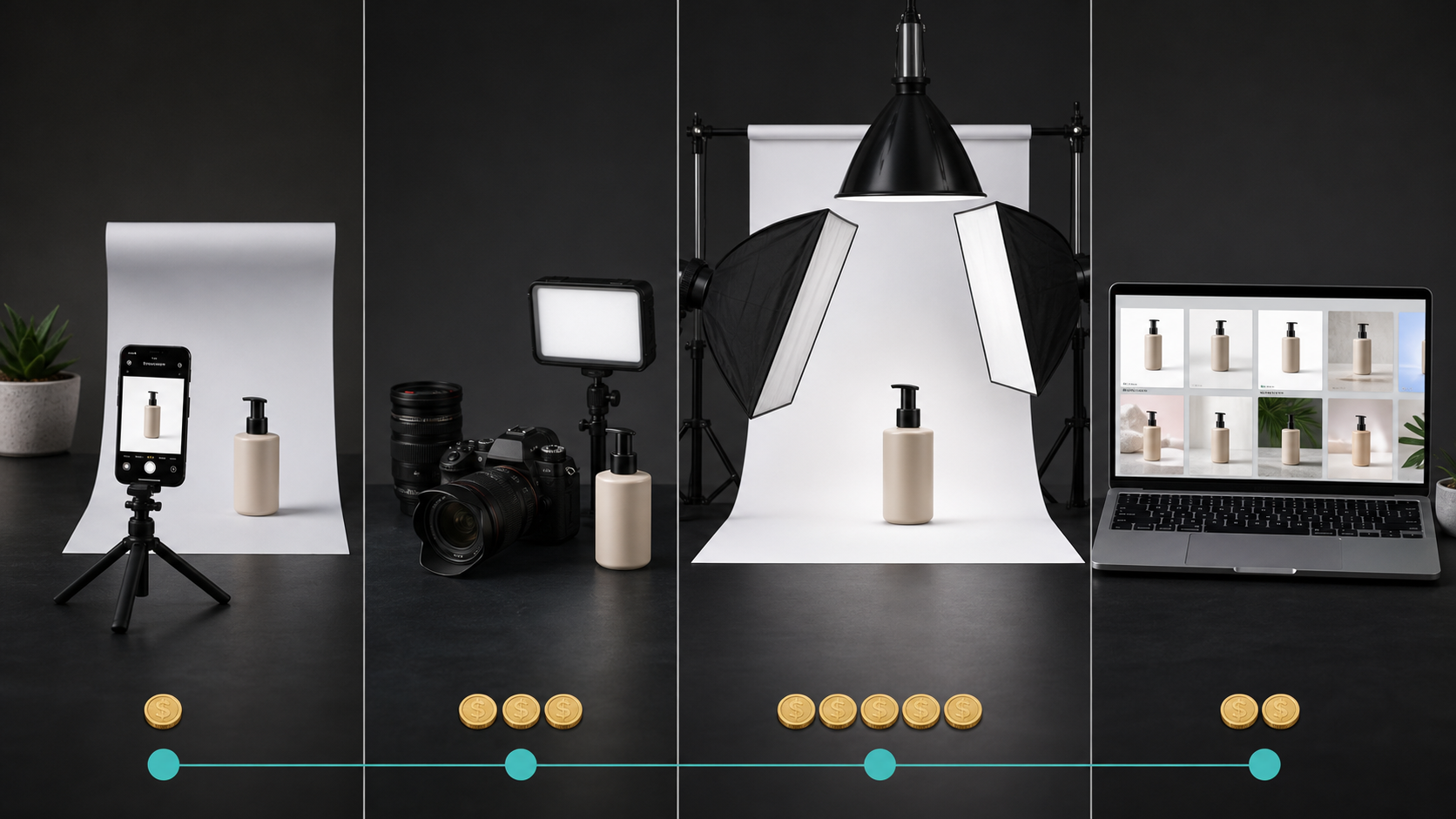
AI tools are fastest and cheapest, but only if you have a clean source image. I've generated product images with AI in 10 minutes flat, costing about £2-3 per product. The catch? Complex materials, logos, and accuracy-critical details still need human review. I once had AI-generated images with distorted logos—had to reshoot anyway.
DIY saves money but costs time. I bought a basic lighting kit for about £150. But shooting one product takes 30 minutes—positioning, lighting, shooting, editing. Ten products means five hours, not counting the learning curve. My first attempt: two hours just adjusting lights, and I still wasn't happy with the results.
Freelancers offer flexibility but quality varies wildly. I've worked with three different photographers. One was brilliant but communication-heavy, another was efficient but rough on retouching, the third was cheap but the images always lacked polish.
Professional studios are priciest but most consistent. I used one once—double the cost of a freelancer—but the quality was excellent, the process was smooth, and I barely had to think about it. The downside: at scale, the costs really add up.
What 10, 100, or 1,000 Products Actually Cost
Here's a practical example to show how costs scale.
Assumptions: simple non-clothing, non-jewellery products, 3 white background images per SKU, no models, complex props, rush fees, or special licensing.
10 products: AI roughly £60-75, DIY £450-1,100, freelancer £650-1,400, studio £850-2,200.
100 products: AI roughly £600-700, DIY £1,500-2,900, freelancer £5,900-12,000, studio £7,200-15,000.
1,000 products: AI roughly £6,000-7,000, DIY £12,000-20,500, freelancer £58,500-117,000, studio £70,000-141,000.
The key insight: traditional photography costs scale roughly linearly with the number of products. AI costs scale much more slowly because the main expense is source images and credits, not time per product. For high-volume, consistent-style catalogues, the cost difference becomes dramatic.
But—this is important—these estimates assume simple products. If you need lifestyle shots, models, jewellery, or complex materials, AI's advantage shrinks because you'll need more human QA, more reruns, and more careful review.
What I Actually Do Now
After months of trial and error, I've settled on a hybrid approach.
For hero images, new product launches, and anything requiring models or styled scenes, I use a professional photographer. These images represent my brand—they need to be right.
But for catalogue refreshes, seasonal updates, and multi-channel variants, I use AI tools. If I have a clean white background image, generating different backgrounds or adapting to different platform sizes takes minutes and costs almost nothing.
A quick note on ProductShotAI—it can generate white background, studio, and lifestyle scenes from your existing product photos, but only if your source images are clean, well-lit, and clearly defined. AI extends good images; it can't rescue bad ones. So rather than hoping AI will fix your mistakes, get the basics right first, then let AI help you scale efficiently.
Final Thoughts
Product photography pricing is complex because product photography itself is complex. The same service can cost ten times more depending on materials, style, and turnaround.
It took me three months to figure all this out. I hope you don't have to go through the same learning curve. When you get a quote, don't just look at the total—check what's included and what isn't. When choosing an approach, don't just look at unit cost—consider total cost of ownership, including your time, communication overhead, and reshoot risk.
Most importantly, don't expect one solution to fit every situation. Invest in your hero images, economise on routine updates. Finding the right balance for your business stage matters far more than finding the cheapest option.